Top Fluted Wall Panels for Global Buyers?
For global buyers, choosing the right Fluted Wall panel involves more than matching a catalogue color. The surface may look similar, yet its core, coating, and installation performance can differ greatly. A panel that feels warm in a showroom might swell in a humid bathroom. A lightweight board might reduce freight costs, but it may need stronger backing. Small details matter.
Interior designer Kelly Wearstler has said, “Texture is everything.” Her view explains the lasting appeal of fluted surfaces. Their vertical grooves catch daylight, soften plain walls, and create subtle shadow lines across offices, hotels, restaurants, and homes. Still, beauty cannot replace evidence. Buyers should request material samples, technical data, fire-performance information, moisture resistance, acoustic results, and installation instructions. Certifications should be checked, not simply displayed in a sales brochure.
This guide examines leading Fluted Wall options for international projects. It considers PVC, MDF, WPC, acoustic felt, and wood veneer panels. It also reviews groove depth, panel width, color consistency, edge treatment, packaging, minimum order quantities, and replacement support. A reliable supplier should explain tolerances clearly. They should also provide realistic lead times and photographs from completed installations.
There is no perfect panel.
A low price can hide higher installation costs. A premium finish can still fail without suitable wall preparation. Global buyers must compare the complete system, not only the square-meter price. This introduction offers a practical starting point, while recognizing one uncomfortable truth: product claims deserve independent verification before large-scale purchase.
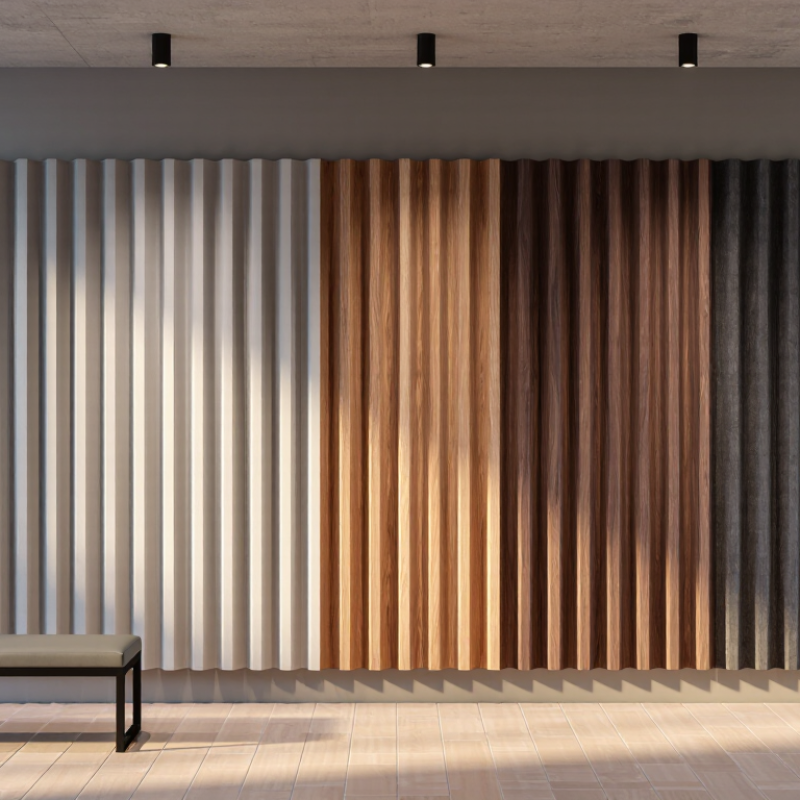
Fluted Wall Panel Types: PVC, WPC, MDF, and PET Acoustic Systems
Fluted Wall Panels for Global Buyers
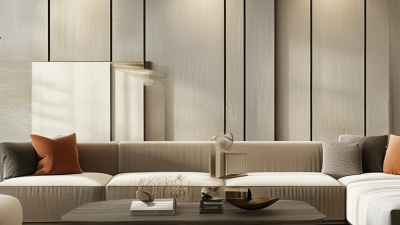
Fluted wall panels combine texture, warmth, and practical surface protection.
PVC panels suit humid rooms because they resist moisture and clean easily. However, their finish may look less natural under strong lighting.
WPC panels offer a wood-like appearance with better moisture tolerance than many traditional boards. They work well in hospitality areas, offices, and covered outdoor spaces.
MDF panels provide precise grooves and a smooth decorative surface. They are often cost-effective for dry interiors, but exposed edges need careful sealing.
PET acoustic panels can soften echoes in meeting rooms, studios, and open-plan workplaces. Their performance depends on thickness, backing, spacing, and installation quality. Decorative flutes alone do not guarantee sound control.
Tips:
Match the panel to the room before comparing prices. Request samples, technical data, cleaning guidance, and installation instructions. Check moisture resistance for bathrooms or coastal projects. For MDF, inspect edge treatment and substrate flatness. For PET systems, review tested acoustic values instead of trusting broad claims. Confirm dimensions, color consistency, packing strength, and replacement availability before shipment.
Small details matter. A cheaper panel may create higher labor costs later. I have seen attractive samples fail when installers ignored expansion gaps or uneven walls. That mistake is easy to underestimate. Global buyers should also verify local fire, building, and indoor-air requirements with qualified professionals.
Core Specifications: 8–25 mm Thickness, 1220 mm Width, and Density Ratings
For global buyers, fluted wall panels should be compared by measurable specifications, not appearance alone. Common thicknesses range from 8 to 25 mm. An 8 mm panel suits lightweight decorative applications, while 15–25 mm panels offer better rigidity and screw-holding performance. The standard 1220 mm width can reduce installation joints, especially on broad interior walls. Measure the wall carefully. Small errors become visible at every flute.
Density ratings need equal attention. Many composite panels fall near 0.45–0.75 g/cm³, but the figure depends on the core, resin content, and manufacturing process. Higher density usually improves impact resistance and edge stability, yet it can increase weight and shipping cost. ASTM D792-20 provides a recognized method for measuring density, while ASTM D1037 supports evaluation of wood-based panel performance. Buyers should request test conditions, not only a single density number.
Industry demand also supports closer specification control. Grand View Research’s 2024 wall panels market analysis projects continued global growth through the decade, increasing pressure on suppliers to provide comparable technical data. However, density alone does not prove durability. I would also check moisture behavior, surface hardness, fire classification, and dimensional change. Some product sheets remain vague. That is a warning, not a minor omission. Sample testing under local temperature and humidity conditions can reveal problems before a full container is purchased.
Top Fluted Wall Panels for Global Buyers? - Core Specifications: 8–25 mm Thickness, 1220 mm Width, and Density Ratings
| Panel Type |
Typical Core Material |
Thickness
(mm) |
Standard Width
(mm) |
Common Lengths
(mm) |
Density
(kg/m³) |
Flute Depth
(mm) |
Approx. Weight
(kg/m²) |
Typical Interior Use |
| Decorative MDF Fluted Panel |
Medium-density fibreboard with decorative veneer or paint finish |
18 |
1220 |
2440–2800 |
600–750 |
8–15 |
10.8–13.5 |
Feature walls, offices, retail interiors and reception areas |
| Moisture-Resistant MDF Fluted Panel |
Moisture-resistant fibreboard with sealed or laminated surface |
18–25 |
1220 |
2440–3050 |
600–750 |
8–18 |
10.8–18.8 |
Kitchens, covered commercial areas and humid interior spaces |
| PET Acoustic Fluted Panel |
Recycled polyester acoustic felt, usually bonded to a rigid backing |
9–12 |
1220 |
2400–3000 |
180–250 |
12–25 |
1.6–3.0 |
Open-plan offices, meeting rooms, studios and hospitality interiors |
| PVC Fluted Wall Panel |
Rigid or foamed polyvinyl chloride with decorative film or print |
8–10 |
1220 |
2440–3000 |
450–700 |
10–20 |
3.6–7.0 |
Bathrooms, retail displays and areas requiring easy surface cleaning |
| WPC Fluted Wall Panel |
Wood-plastic composite containing wood fibre and thermoplastic polymer |
21–25 |
1220 |
2900–3000 |
550–750 |
20–35 |
11.6–18.8 |
Interior accent walls and semi-protected areas; confirm moisture limits before use |
| Aluminium Fluted Panel |
Roll-formed or extruded aluminium, often with a powder-coated finish |
8–20 |
1220 |
2400–6000 |
2700–2750 |
15–40 |
21.6–55.0 |
High-traffic interiors, commercial lobbies and selected exterior applications |
Buyer’s specification note:
Values are representative ranges for commonly supplied fluted wall-panel constructions. Actual density, weight, dimensional tolerance, fire performance, acoustic rating, moisture resistance and surface finish depend on the panel structure and test standard. Confirm the technical datasheet and required certification for each project before purchase.
Fire Compliance: ASTM E84 Class A and EN 13501-1 Reaction Classes
Global buyers often compare fluted wall panels by appearance first, but fire documentation deserves equal attention. ASTM E84 Class A indicates a flame spread index of 0–25 and a smoke-developed index of 450 or less. It is a surface-burning test, not a complete fire-resistance rating.
EN 13501-1 uses a different classification system.
Reaction classes range from A1 and A2 to B, C, D, E, and F. Smoke production uses s1, s2, or s3, while flaming droplets use d0, d1, or d2. A panel rated B-s1,d0 is not automatically equivalent to ASTM E84 Class A. The test methods and reporting rules differ.
Check the full assembly.
Substrate, adhesive, cavity depth, coating, thickness, and installation can change performance. Ask for current reports from an independent laboratory, not only a sales datasheet. Verify that the tested configuration matches the project detail, including joints and backing surfaces. Small gaps matter.
Read the fine print.
In practical specification reviews, missing installation conditions are a recurring weakness. A panel may pass testing alone but perform differently when fixed over combustible insulation. This is easy to overlook. Local code officials should confirm acceptance before purchase, especially for hospitals, hotels, transport areas, and tall buildings. Fire classification is technical evidence, not a universal approval.
Acoustic Performance: PET Panels with NRC Values of 0.40–0.85
Fluted wall panels made from PET are gaining attention among global buyers seeking calmer interiors. Their Noise Reduction Coefficient, or NRC, commonly ranges from 0.40 to 0.85. A higher NRC usually means stronger absorption of reflected sound. Yet the number needs context.
I have seen panels rated at NRC 0.85 perform differently in finished rooms. Installation gaps, wall surfaces, ceiling height, and furniture placement all influence the result. A 0.40 panel may still improve speech clarity in a small meeting room. It may be enough.
Buyers should request laboratory test reports, not only catalogue claims. Reliable reports identify the test method, sample thickness, mounting condition, and frequency range. ASTM C423 and ISO 354 are commonly referenced, but their results require careful comparison. Some suppliers test panels with an air cavity behind them. Others test direct wall installation. These conditions are not equivalent.
PET density and fluted depth also affect performance. Deeper grooves can increase surface area, while a concealed acoustic backing may improve low-frequency absorption. However, decorative flutes alone do not guarantee acoustic control. That assumption is easy to make.
For overseas projects, confirm fire classification, indoor air documentation, dimensions, packaging, and installation guidance. Local building requirements may differ. Ask for samples and test them in a representative space before ordering large quantities. A small room trial can reveal echoes, visible joints, or unexpected color changes under lighting. NRC is useful, but it is not the whole acoustic story.
Top Fluted Wall Panels for Global Buyers: Acoustic Performance
Noise Reduction Coefficient (NRC) values for PET acoustic panels commonly range from 0.40 to 0.85. Higher values indicate greater average sound absorption across the standard mid-frequency test range.
Typical NRC values shown are rounded performance levels for PET panel assemblies. Actual results depend on panel thickness, fluted geometry, mounting method, backing material, air space, and laboratory testing conditions. NRC is commonly determined using ASTM C423.
Global Buyer Checklist: E1 Emissions, Moisture Resistance, MOQ, and Freight Terms
Top Fluted Wall Panels for Global Buyers?
Global buyers should treat E1 emissions as a document check, not a marketing phrase. Request a recent laboratory report showing the test standard, sample date, and production batch. Compare the report with the actual core material and surface finish.
A low-emission panel can still perform poorly in humid rooms. Moisture resistance is not waterproofing. Ask for swelling data, edge-sealing details, and test results after repeated humidity exposure.
I would also inspect a sample after several days near a bathroom or unheated storage area. This is not a perfect laboratory test, but it can reveal weak edges and inconsistent coating.
MOQ often changes the real purchase cost. Confirm whether it applies per color, profile, size, or full container. Ask for carton dimensions, pallet quantity, gross weight, and replacement policy for damaged pieces.
Freight terms need equal attention. Clarify whether the quotation uses EXW, FOB, CIF, or DDP terms, and identify who handles export documents, insurance, port charges, and local delivery.
One overlooked detail can erase a seemingly attractive price. My own early mistake was comparing panel prices before calculating cubic volume. Fluted profiles may use more space than expected.
Request a packed sample and a written lead-time schedule before approving production. Keep every specification in one signed document. Verbal promises are easy to misremember.